Hassan Allaam Holding
AI & Data Science Training Academy
Corporate Training Report
Hassan Allam Holding Puts AI to Work Across Daily Operations
Over four instructor-led days, dotpy.tech trained two batches of operational heads from one of Egypt's largest engineering and construction groups to apply AI to the work they run every day.

- Batches
- 2Parallel cohorts
- Duration
- 2 daysPer batch
- Training days
- 4Total delivery
- Audience
- Operational headsDepartment & function leads
- Modules
- 2Operations & Claude ecosystem
When a group builds power plants, tunnels, museums and water networks across ten countries, the question is never whether AI is interesting — it is whether AI can survive contact with a live operation. dotpy.tech built this program around that test, taking two batches of Hassan Allam Holding's operational heads through four days of hands-on work with the tools they would use the following morning. Every exercise started from the group's own operational reality: reports that must be written, meetings that must be captured, data that must be turned into a decision.


The client
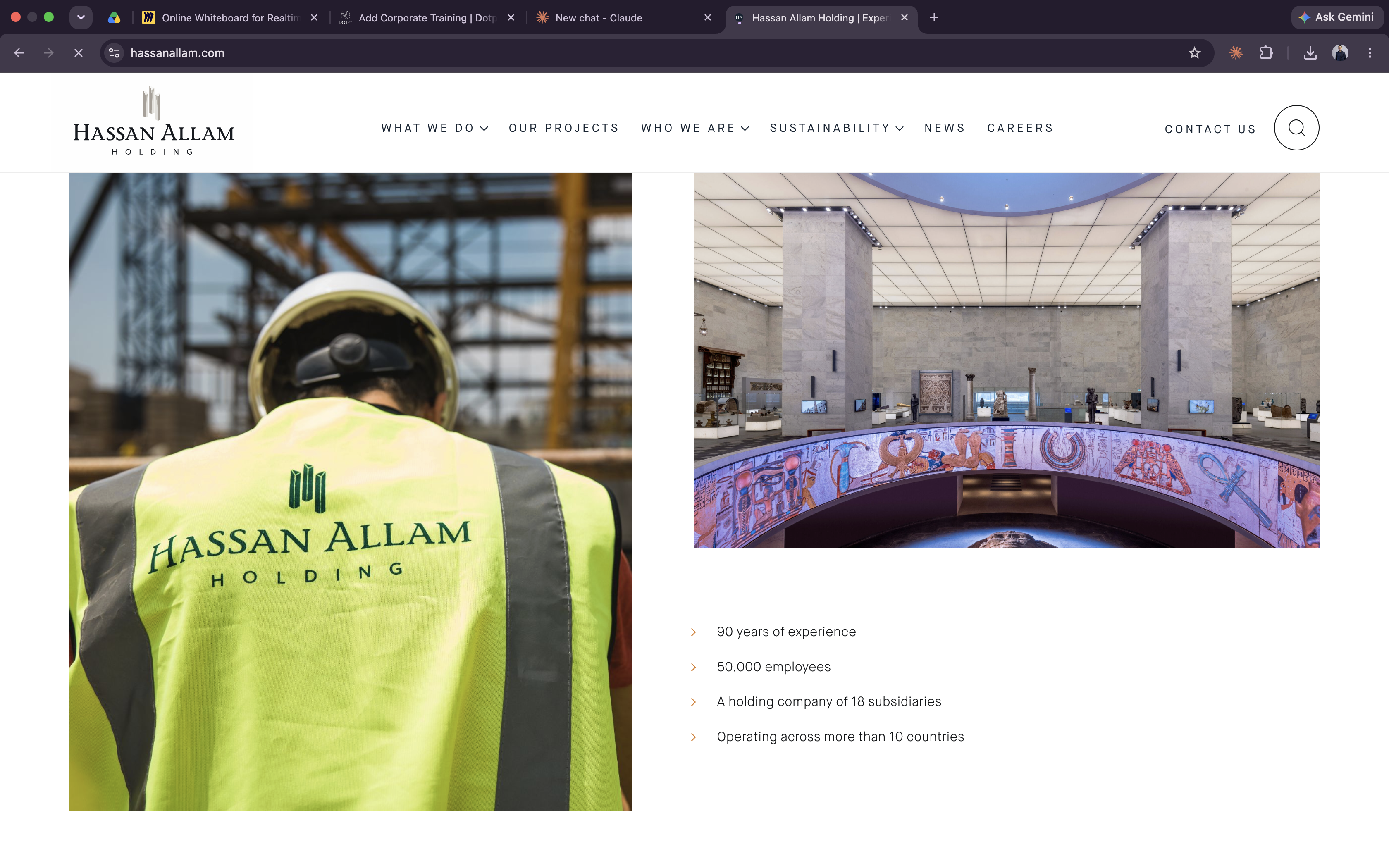
Hassan Allam Holding is one of Egypt's most established engineering, construction and investment groups, with a portfolio spanning infrastructure, energy, water, industrial and landmark cultural projects.
- 90 yearsOf operating experience
- 50,000Employees
- 18Subsidiaries
- 10+Countries of operation

AI for Daily Operations
The opening module addressed the part of AI adoption that most organizations skip: identifying precisely where, inside an existing operation, an AI tool creates measurable time savings without introducing risk. Rather than beginning with technology, dotpy.tech's trainer began with the operational day itself — the progress reports, site updates, correspondence, meeting minutes, tenders, specifications and status summaries that consume the working hours of a department head at a group the scale of Hassan Allam Holding. Participants mapped their own recurring tasks and learned to classify each one by how well it suits an AI assistant, a rule-based automation, or neither.
From that map, the session moved into practice. Teams worked through prompt construction as an operational skill rather than a novelty: giving the model the context it needs, supplying source documents instead of expecting recall, specifying the output format a stakeholder actually requires, and iterating on a draft rather than accepting the first response. Participants drafted and refined real operational writing during the session — a progress summary, a client-facing update, a structured comparison — and saw directly how much of the quality gap between a weak and a strong result is determined by the instruction rather than the tool.
The module closed on judgement and control, which for an operational audience matters as much as capability. dotpy.tech covered where AI output must be verified before it leaves the department, how to handle commercially sensitive information responsibly, and why a human owner remains accountable for every figure and commitment in a generated document. Participants left with a clear view of which of their tasks are ready to hand over, which need a human check at the end, and which should stay untouched — a distinction that turns enthusiasm into a defensible internal policy.
Covered in this module
- Operational task mapping — auditing a department's recurring work for AI-suitable tasks
- Practical prompt construction — context, source material, output specification, iteration
- Operational writing at speed — reports, updates, minutes, summaries and correspondence
- Analysis and comparison — turning raw figures and documents into a decision-ready view
- Verification and data discipline — what to check, what to protect, who stays accountable
The Claude Ecosystem for Daily Tasks
The second module narrowed from principles to a single working environment, examining how one AI ecosystem covers an operational day end to end. Participants were walked through the full surface area of Claude as a working tool — the chat environment and its artifacts for producing reviewable deliverables, Projects for keeping a department's standing context and reference documents in one place, Skills for encoding a repeatable procedure so it runs the same way every time, and connectors for reaching the systems where work actually lives. Presented as a connected ecosystem rather than a list of features, the picture made clear how a single assistant can hold a department's context instead of starting cold with every request.
Two live demonstrations anchored the module. In the first, a shared whiteboard from a working meeting was read, summarized and then expanded into a detailed, properly structured document ready for export and circulation — the full path from a rough session to a distributable deliverable, completed in front of the group. In the second, a folder of raw operational datasets was analyzed in place: files inspected, statistics computed, and a finished infographic produced for each dataset and saved back to the folder, with the assistant's plan visible step by step as it worked. For heads accustomed to routing this work through several people and several days, seeing the loop close in minutes reframed what a working assistant can be trusted with.
The module ended on institutionalization. Participants discussed how to convert what they had just watched into standing departmental practice: which recurring outputs deserve a documented procedure, how to write instructions precise enough that a colleague gets the same result, where to keep shared context so knowledge does not sit with one individual, and how to introduce these tools to their own teams without losing the review discipline established in the first module. The objective throughout was durability — capability that remains in the department after the training days end.
Covered in this module
- The ecosystem in full — chat, artifacts, Projects, Skills, connectors and the browser extension
- Meeting to deliverable — capturing a working session and producing a circulation-ready document
- Working with real files — reading a folder of datasets, computing statistics, generating visuals
- Repeatable procedures — encoding a recurring task so the output is consistent every time
- Departmental rollout — shared context, written instructions and review discipline for teams
We came in expecting a demonstration. We left with tasks already moved off our desks.Training Participant — Hassan Allam Holding
What the cohorts took away
Outcomes across both batches, four days of delivery.
- ✓A department-level map of which recurring operational tasks are ready for AI, which need human review, and which stay manual
- ✓Working command of prompt construction as an operational skill, applied to their own reports and correspondence
- ✓Fluency across the Claude ecosystem — artifacts, Projects, Skills and connectors — rather than chat alone
- ✓A proven meeting-to-deliverable workflow that turns a working session into a circulation-ready document
- ✓The ability to analyze operational data files directly and produce decision-ready visuals without a handoff
- ✓A shared verification and data-handling standard the operational heads can apply across their own teams
Partner with us for your next corporate AI training
dotpy.tech is an AI and data science training academy working with organizations across Egypt and the wider MENA region. We design and deliver corporate programs that start from a client's real operations — AI for business, applied automation, prompt engineering, no-code AI and developer-focused training — and we build every session around the work participants return to the next morning.
Programs are delivered in English or Arabic, online or on site, and scoped to the batch structure and seniority of your teams.